
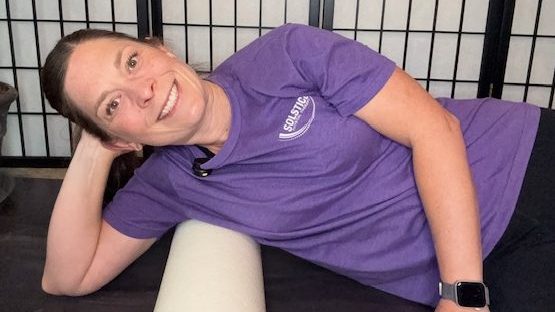
If you’ve had Myofascial Release (MFR) treatments before, you’ve probably experienced the profound, lasting relief that MFR can bring after a session. You might walk out of our office feeling lighter, more aligned, and in less pain. But for true, sustained healing, the work can’t stop when you leave the treatment table—that’s where at-home self-care comes in. At Solstice Physical Therapy, we emphasize self-treatment because it’s a large and necessary part of the Myofascial Release approach. Consistent self-care at home between sessions improves your body’s ability to heal and maintain its released state.
Myofascial Release works on your fascial system, a continuous, interconnected web of connective tissue that runs from the top of your head to the bottom of your feet. Trauma, inflammation, and chronic tension can cause the fascia to become restricted, which can produce immense crushing pressures on pain-sensitive structures—up to 2,000 pounds per square inch (crazy, right?).
While our hands-on sessions help initiate a deep, sustained release, consistent self-care helps your body continue those changes on a cellular level.
- It’s Not a Quick Stretch: Unlike traditional stretching that only releases the elastic component of the muscle, MFR techniques target the tough, collagenous barrier of the fascia. This deeper release requires a sustained, gentle force.
- The 5-Minute Rule: When using your self-treatment tools, the “magic” really starts happening after about 5 minutes of sustained pressure. Holding a release for a minimum of 90-120 seconds, or even better, 5 minutes, is what allows the collagenous barrier to elongate and the ground substance (the gel-like fluid in your fascia) to thin and “melt”.
To get the most out of your self-care, focus on these key elements that we teach in our practice:
- Use the Right Tools: Tools like a foam roll, Craniocradle, Theracane, or a softer 4 or 5-inch ball are excellent for applying the sustained pressure needed for a deep release. Get creative with your positioning, and remember that a slightly bigger and softer ball can be gentler and more effective for longer releases than a lacrosse or tennis ball.
- Sustain the Hold: When you find a “tight and/or tender” area, place your ball there and find a position where you can fully relax into the pressure for at least 5 minutes.
- Focus and Breathe: Bring your full attention to the stretch as you hold it. Focus on listening to your body and make sure you are breathing easily and deeply.
- Hydrate and Rest: After your release, always drink plenty of water to help your body continue the release and improve blood flow. A nice, warm bath with Epsom salts can also help to decrease inflammation.
MFR is a whole-body approach that offers more than just physical relief. The body’s tissues can store memories of past traumas, and MFR can help you process emotions that have been held in the body as chronic tension. Retracing—the temporary return of old symptoms, pain, or emotions—can be a normal, temporary part of this deeper healing process, indicating that your body is working through deep-seated issues. Consistent self-care helps guide your body through this journey.
By committing to your self-care program between sessions, you are not just managing pain—you are participating in your own long-lasting recovery. You are giving your body the consistent attention it needs to maintain the releases achieved in the clinic, allowing you to live your best life.
For videos about Myofascial Release self-care techniques that you can easily do at home, visit my YouTube site: https://www.youtube.com/@lisawilcoxpt
Always feel free to contact me at DrLisa@SolsticePhysicalTherapy.com with any questions and visit my website for more information at www.SolsticePhysicalTherapy.com.
**This is not to be considered medical advice, please contact a physical therapist or other healthcare professional for more information. All content on lisawilcoxpt.com is created for informational purposes only and is not to be taken as medical advice, treatment or diagnosis.

 lisawilcoxpt.com